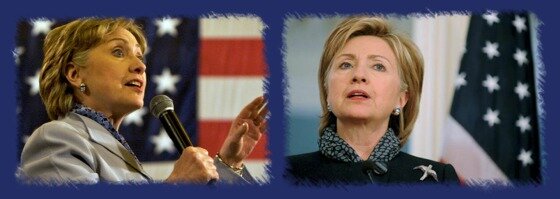
The Hillary Clinton Quarterly has been keeping up with Hillary's career since 1992 when she became First Lady. As Secretary of State, Hillary carries out the President's foreign policies through the State Department and the Foreign Service of the United States. She was sworn in as the 67th Secretary of State of the United States on January 21, 2009.
2012 Election Merchandise - CLICK HERE!
SECRETARY CLINTON: Thank you very much,
Alberto, for not only that kind introduction but your and
your colleagues’ leadership of this important institution.
It’s a pleasure to be here at the Newseum. The Newseum is a
monument to some of our most precious freedoms, and I’m
grateful for this opportunity to discuss how those freedoms
apply to the challenges of the 21st century.
Although I can’t see all of you because in settings like
this, the lights are in my eyes and you are in the dark, I
know that there are many friends and former colleagues. I
wish to acknowledge Charles Overby, the CEO of Freedom Forum
here at the Newseum; Senator Edward Kaufman and Senator Joe
Lieberman, my former colleagues in the Senate, both of whom
worked for passage of the Voice Act, which speaks to
Congress’s and the American people’s commitment to internet
freedom, a commitment that crosses party lines and branches
of government.
Also, I’m told here as well are Senator Sam Brownback,
Senator Ted Kaufman, Representative Loretta Sanchez, many
representatives of the Diplomatic Corps, ambassadors,
chargés, participants in our International Visitor
Leadership Program on internet freedom from China, Colombia,
Iran, and Lebanon, and Moldova. And I also want to
acknowledge Walter Isaacson, president of the Aspen
Institute, recently named to our Broadcasting Board of
Governors and, of course, instrumental in supporting the
work on internet freedom that the Aspen Institute has been
doing.
This is an important speech on a very important subject. But
before I begin, I want to just speak briefly about Haiti,
because during the last eight days, the people of Haiti and
the people of the world have joined together to deal with a
tragedy of staggering proportions. Our hemisphere has seen
its share of hardship, but there are few precedents for the
situation we’re facing in Port-au-Prince. Communication
networks have played a critical role in our response. They
were, of course, decimated and in many places totally
destroyed. And in the hours after the quake, we worked with
partners in the private sector; first, to set up the text
“HAITI” campaign so that mobile phone users in the United
States could donate to relief efforts via text messages.
That initiative has been a showcase for the generosity of
the American people, and thus far, it’s raised over $25
million for recovery efforts.
Information networks have also played a critical role on the
ground. When I was with President Preval in Port-au-Prince
on Saturday, one of his top priorities was to try to get
communication up and going. The government couldn’t talk to
each other, what was left of it, and NGOs, our civilian
leadership, our military leadership were severely impacted.
The technology community has set up interactive maps to help
us identify needs and target resources. And on Monday, a
seven-year-old girl and two women were pulled from the
rubble of a collapsed supermarket by an American
search-and-rescue team after they sent a text message
calling for help. Now, these examples are manifestations of
a much broader phenomenon.
The spread of information networks is forming a new nervous
system for our planet. When something happens in Haiti or
Hunan, the rest of us learn about it in real time – from
real people. And we can respond in real time as well.
Americans eager to help in the aftermath of a disaster and
the girl trapped in the supermarket are connected in ways
that were not even imagined a year ago, even a generation
ago. That same principle applies to almost all of humanity
today. As we sit here, any of you – or maybe more likely,
any of our children – can take out the tools that many carry
every day and transmit this discussion to billions across
the world.
Now, in many respects, information has never been so free.
There are more ways to spread more ideas to more people than
at any moment in history. And even in authoritarian
countries, information networks are helping people discover
new facts and making governments more accountable.
During his visit to China in November, for example,
President Obama held a town hall meeting with an online
component to highlight the importance of the internet. In
response to a question that was sent in over the internet,
he defended the right of people to freely access
information, and said that the more freely information
flows, the stronger societies become. He spoke about how
access to information helps citizens hold their own
governments accountable, generates new ideas, encourages
creativity and entrepreneurship. The United States belief in
that ground truth is what brings me here today.
Because amid this unprecedented surge in connectivity, we
must also recognize that these technologies are not an
unmitigated blessing. These tools are also being exploited
to undermine human progress and political rights. Just as
steel can be used to build hospitals or machine guns, or
nuclear power can either energize a city or destroy it,
modern information networks and the technologies they
support can be harnessed for good or for ill. The same
networks that help organize movements for freedom also
enable al-Qaida to spew hatred and incite violence against
the innocent. And technologies with the potential to open up
access to government and promote transparency can also be
hijacked by governments to crush dissent and deny human
rights.
In the last year, we’ve seen a spike in threats to the free
flow of information. China, Tunisia, and Uzbekistan have
stepped up their censorship of the internet. In Vietnam,
access to popular social networking sites has suddenly
disappeared. And last Friday in Egypt, 30 bloggers and
activists were detained. One member of this group, Bassem
Samir, who is thankfully no longer in prison, is with us
today. So while it is clear that the spread of these
technologies is transforming our world, it is still unclear
how that transformation will affect the human rights and the
human welfare of the world’s population.
On their own, new technologies do not take sides in the
struggle for freedom and progress, but the United States
does. We stand for a single internet where all of humanity
has equal access to knowledge and ideas. And we recognize
that the world’s information infrastructure will become what
we and others make of it. Now, this challenge may be new,
but our responsibility to help ensure the free exchange of
ideas goes back to the birth of our republic. The words of
the First Amendment to our Constitution are carved in 50
tons of Tennessee marble on the front of this building. And
every generation of Americans has worked to protect the
values etched in that stone.
Franklin Roosevelt built on these ideas when he delivered
his Four Freedoms speech in 1941. Now, at the time,
Americans faced a cavalcade of crises and a crisis of
confidence. But the vision of a world in which all people
enjoyed freedom of expression, freedom of worship, freedom
from want, and freedom from fear transcended the troubles of
his day. And years later, one of my heroes, Eleanor
Roosevelt, worked to have these principles adopted as a
cornerstone of the Universal Declaration of Human Rights.
They have provided a lodestar to every succeeding
generation, guiding us, galvanizing us, and enabling us to
move forward in the face of uncertainty.
So as technology hurtles forward, we must think back to that
legacy. We need to synchronize our technological progress
with our principles. In accepting the Nobel Prize, President
Obama spoke about the need to build a world in which peace
rests on the inherent rights and dignities of every
individual. And in my speech on human rights at Georgetown a
few days later, I talked about how we must find ways to make
human rights a reality. Today, we find an urgent need to
protect these freedoms on the digital frontiers of the 21st
century.
There are many other networks in the world. Some aid in the
movement of people or resources, and some facilitate
exchanges between individuals with the same work or
interests. But the internet is a network that magnifies the
power and potential of all others. And that’s why we believe
it’s critical that its users are assured certain basic
freedoms. Freedom of expression is first among them. This
freedom is no longer defined solely by whether citizens can
go into the town square and criticize their government
without fear of retribution. Blogs, emails, social networks,
and text messages have opened up new forums for exchanging
ideas, and created new targets for censorship.
As I speak to you today, government censors somewhere are
working furiously to erase my words from the records of
history. But history itself has already condemned these
tactics. Two months ago, I was in Germany to celebrate the
20th anniversary of the fall of the Berlin Wall. The leaders
gathered at that ceremony paid tribute to the courageous men
and women on the far side of that barrier who made the case
against oppression by circulating small pamphlets called
samizdat. Now, these leaflets questioned the claims and
intentions of dictatorships in the Eastern Bloc and many
people paid dearly for distributing them. But their words
helped pierce the concrete and concertina wire of the Iron
Curtain.
The Berlin Wall symbolized a world divided and it defined an
entire era. Today, remnants of that wall sit inside this
museum where they belong, and the new iconic infrastructure
of our age is the internet. Instead of division, it stands
for connection. But even as networks spread to nations
around the globe, virtual walls are cropping up in place of
visible walls.
Some countries have erected electronic barriers that prevent
their people from accessing portions of the world’s
networks. They’ve expunged words, names, and phrases from
search engine results. They have violated the privacy of
citizens who engage in non-violent political speech. These
actions contravene the Universal Declaration on Human
Rights, which tells us that all people have the right “to
seek, receive and impart information and ideas through any
media and regardless of frontiers.” With the spread of these
restrictive practices, a new information curtain is
descending across much of the world. And beyond this
partition, viral videos and blog posts are becoming the
samizdat of our day.
As in the dictatorships of the past, governments are
targeting independent thinkers who use these tools. In the
demonstrations that followed Iran’s presidential elections,
grainy cell phone footage of a young woman’s bloody murder
provided a digital indictment of the government’s brutality.
We’ve seen reports that when Iranians living overseas posted
online criticism of their nation’s leaders, their family
members in Iran were singled out for retribution. And
despite an intense campaign of government intimidation,
brave citizen journalists in Iran continue using technology
to show the world and their fellow citizens what is
happening inside their country. In speaking out on behalf of
their own human rights, the Iranian people have inspired the
world. And their courage is redefining how technology is
used to spread truth and expose injustice.
Now, all societies recognize that free expression has its
limits. We do not tolerate those who incite others to
violence, such as the agents of al-Qaida who are, at this
moment, using the internet to promote the mass murder of
innocent people across the world. And hate speech that
targets individuals on the basis of their race, religion,
ethnicity, gender, or sexual orientation is reprehensible.
It is an unfortunate fact that these issues are both growing
challenges that the international community must confront
together. And we must also grapple with the issue of
anonymous speech. Those who use the internet to recruit
terrorists or distribute stolen intellectual property cannot
divorce their online actions from their real world
identities. But these challenges must not become an excuse
for governments to systematically violate the rights and
privacy of those who use the internet for peaceful political
purposes.
The freedom of expression may be the most obvious freedom to
face challenges with the spread of new technologies, but it
is not the only one. The freedom of worship usually involves
the rights of individuals to commune or not commune with
their Creator. And that’s one channel of communication that
does not rely on technology. But the freedom of worship also
speaks to the universal right to come together with those
who share your values and vision for humanity. In our
history, those gatherings often took place in churches,
synagogues, mosques and temples. Today, they may also take
place on line.
The internet can help bridge divides between people of
different faiths. As the President said in Cairo, freedom of
religion is central to the ability of people to live
together. And as we look for ways to expand dialogue, the
internet holds out such tremendous promise. We’ve already
begun connecting students in the United States with young
people in Muslim communities around the world to discuss
global challenges. And we will continue using this tool to
foster discussion between individuals from different
religious communities.
Some nations, however, have co-opted the internet as a tool
to target and silence people of faith. Last year, for
example, in Saudi Arabia, a man spent months in prison for
blogging about Christianity. And a Harvard study found that
the Saudi Government blocked many web pages about Hinduism,
Judaism, Christianity, and even Islam. Countries including
Vietnam and China employed similar tactics to restrict
access to religious information.
Now, just as these technologies must not be used to punish
peaceful political speech, they must also not be used to
persecute or silence religious minorities. Now, prayers will
always travel on higher networks. But connection
technologies like the internet and social networking sites
should enhance individuals’ ability to worship as they see
fit, come together with people of their own faith, and learn
more about the beliefs of others. We must work to advance
the freedom of worship online just as we do in other areas
of life.
There are, of course, hundreds of millions of people living
without the benefits of these technologies. In our world, as
I’ve said many times, talent may be distributed universally,
but opportunity is not. And we know from long experience
that promoting social and economic development in countries
where people lack access to knowledge, markets, capital, and
opportunity can be frustrating and sometimes futile work. In
this context, the internet can serve as a great equalizer.
By providing people with access to knowledge and potential
markets, networks can create opportunities where none exist.
Over the last year, I’ve seen this firsthand in Kenya, where
farmers have seen their income grow by as much as 30 percent
since they started using mobile banking technology; in
Bangladesh, where more than 300,000 people have signed up to
learn English on their mobile phones; and in Sub-Saharan
Africa, where women entrepreneurs use the internet to get
access to microcredit loans and connect themselves to global
markets.
Now, these examples of progress can be replicated in the
lives of the billion people at the bottom of the world’s
economic ladder. In many cases, the internet, mobile phones,
and other connection technologies can do for economic growth
what the Green Revolution did for agriculture. You can now
generate significant yields from very modest inputs. And one
World Bank study found that in a typical developing country,
a 10 percent increase in the penetration rate for mobile
phones led to an almost 1 percent increase in per capita
GDP. To just put this into context, for India, that would
translate into almost $10 billion a year.
A connection to global information networks is like an
on-ramp to modernity. In the early years of these
technologies, many believed that they would divide the world
between haves and have-nots. But that hasn’t happened. There
are 4 billion cell phones in use today. Many of them are in
the hands of market vendors, rickshaw drivers, and others
who’ve historically lacked access to education and
opportunity. Information networks have become a great
leveler, and we should use them together to help lift people
out of poverty and give them a freedom from want.
Now, we have every reason to be hopeful about what people
can accomplish when they leverage communication networks and
connection technologies to achieve progress. But make no
mistake – some are and will continue to use global
information networks for darker purposes. Violent
extremists, criminal cartels, sexual predators, and
authoritarian governments all seek to exploit these global
networks. Just as terrorists have taken advantage of the
openness of our societies to carry out their plots, violent
extremists use the internet to radicalize and intimidate. As
we work to advance freedoms, we must also work against those
who use communication networks as tools of disruption and
fear.
Governments and citizens must have confidence that the
networks at the core of their national security and economic
prosperity are safe and resilient. Now this is about more
than petty hackers who deface websites. Our ability to bank
online, use electronic commerce, and safeguard billions of
dollars in intellectual property are all at stake if we
cannot rely on the security of our information networks.
Disruptions in these systems demand a coordinated response
by all governments, the private sector, and the
international community. We need more tools to help law
enforcement agencies cooperate across jurisdictions when
criminal hackers and organized crime syndicates attack
networks for financial gain. The same is true when social
ills such as child pornography and the exploitation of
trafficked women and girls online is there for the world to
see and for those who exploit these people to make a profit.
We applaud efforts such as the Council on Europe’s
Convention on Cybercrime that facilitate international
cooperation in prosecuting such offenses. And we wish to
redouble our efforts.
We have taken steps as a government, and as a Department, to
find diplomatic solutions to strengthen global cyber
security. We have a lot of people in the State Department
working on this. They’ve joined together, and we created two
years ago an office to coordinate foreign policy in
cyberspace. We’ve worked to address this challenge at the UN
and in other multilateral forums and to put cyber security
on the world’s agenda. And President Obama has just
appointed a new national cyberspace policy coordinator who
will help us work even more closely to ensure that
everyone’s networks stay free, secure, and reliable.
States, terrorists, and those who would act as their proxies
must know that the United States will protect our networks.
Those who disrupt the free flow of information in our
society or any other pose a threat to our economy, our
government, and our civil society. Countries or individuals
that engage in cyber attacks should face consequences and
international condemnation. In an internet-connected world,
an attack on one nation’s networks can be an attack on all.
And by reinforcing that message, we can create norms of
behavior among states and encourage respect for the global
networked commons.
The final freedom, one that was probably inherent in what
both President and Mrs. Roosevelt thought about and wrote
about all those years ago, is one that flows from the four
I’ve already mentioned: the freedom to connect – the idea
that governments should not prevent people from connecting
to the internet, to websites, or to each other. The freedom
to connect is like the freedom of assembly, only in
cyberspace. It allows individuals to get online, come
together, and hopefully cooperate. Once you’re on the
internet, you don’t need to be a tycoon or a rock star to
have a huge impact on society.
The largest public response to the terrorist attacks in
Mumbai was launched by a 13-year-old boy. He used social
networks to organize blood drives and a massive interfaith
book of condolence. In Colombia, an unemployed engineer
brought together more than 12 million people in 190 cities
around the world to demonstrate against the FARC terrorist
movement. The protests were the largest antiterrorist
demonstrations in history. And in the weeks that followed,
the FARC saw more demobilizations and desertions than it had
during a decade of military action. And in Mexico, a single
email from a private citizen who was fed up with
drug-related violence snowballed into huge demonstrations in
all of the country’s 32 states. In Mexico City alone,
150,000 people took to the streets in protest. So the
internet can help humanity push back against those who
promote violence and crime and extremism.
In Iran and Moldova and other countries, online organizing
has been a critical tool for advancing democracy and
enabling citizens to protest suspicious election results.
And even in established democracies like the United States,
we’ve seen the power of these tools to change history. Some
of you may still remember the 2008 presidential election
here. (Laughter.)
The freedom to connect to these technologies can help
transform societies, but it is also critically important to
individuals. I was recently moved by the story of a doctor –
and I won’t tell you what country he was from – who was
desperately trying to diagnose his daughter’s rare medical
condition. He consulted with two dozen specialists, but he
still didn’t have an answer. But he finally identified the
condition, and found a cure, by using an internet search
engine. That’s one of the reasons why unfettered access to
search engine technology is so important in individuals’
lives.
Now, the principles I’ve outlined today will guide our
approach in addressing the issue of internet freedom and the
use of these technologies. And I want to speak about how we
apply them in practice. The United States is committed to
devoting the diplomatic, economic, and technological
resources necessary to advance these freedoms. We are a
nation made up of immigrants from every country and every
interest that spans the globe. Our foreign policy is
premised on the idea that no country more than America
stands to benefit when there is cooperation among peoples
and states. And no country shoulders a heavier burden when
conflict and misunderstanding drive nations apart. So we are
well placed to seize the opportunities that come with
interconnectivity. And as the birthplace for so many of
these technologies, including the internet itself, we have a
responsibility to see them used for good. To do that, we
need to develop our capacity for what we call, at the State
Department, 21st century statecraft.
Realigning our policies and our priorities will not be easy.
But adjusting to new technology rarely is. When the
telegraph was introduced, it was a source of great anxiety
for many in the diplomatic community, where the prospect of
receiving daily instructions from capitals was not entirely
welcome. But just as our diplomats eventually mastered the
telegraph, they are doing the same to harness the potential
of these new tools as well.
And I’m proud that the State Department is already working
in more than 40 countries to help individuals silenced by
oppressive governments. We are making this issue a priority
at the United Nations as well, and we’re including internet
freedom as a component in the first resolution we introduced
after returning to the United Nations Human Rights Council.
We are also supporting the development of new tools that
enable citizens to exercise their rights of free expression
by circumventing politically motivated censorship. We are
providing funds to groups around the world to make sure that
those tools get to the people who need them in local
languages, and with the training they need to access the
internet safely. The United States has been assisting in
these efforts for some time, with a focus on implementing
these programs as efficiently and effectively as possible.
Both the American people and nations that censor the
internet should understand that our government is committed
to helping promote internet freedom.
We want to put these tools in the hands of people who will
use them to advance democracy and human rights, to fight
climate change and epidemics, to build global support for
President Obama’s goal of a world without nuclear weapons,
to encourage sustainable economic development that lifts the
people at the bottom up.
That’s why today I’m announcing that over the next year, we
will work with partners in industry, academia, and
nongovernmental organizations to establish a standing effort
that will harness the power of connection technologies and
apply them to our diplomatic goals. By relying on mobile
phones, mapping applications, and other new tools, we can
empower citizens and leverage our traditional diplomacy. We
can address deficiencies in the current market for
innovation.
Let me give you one example. Let’s say I want to create a
mobile phone application that would allow people to rate
government ministries, including ours, on their
responsiveness and efficiency and also to ferret out and
report corruption. The hardware required to make this idea
work is already in the hands of billions of potential users.
And the software involved would be relatively inexpensive to
develop and deploy.
If people took advantage of this tool, it would help us
target our foreign assistance spending, improve lives, and
encourage foreign investment in countries with responsible
governments. However, right now, mobile application
developers have no financial assistance to pursue that
project on their own, and the State Department currently
lacks a mechanism to make it happen. But this initiative
should help resolve that problem and provide long-term
dividends from modest investments in innovation. We’re going
to work with experts to find the best structure for this
venture, and we’ll need the talent and resources of
technology companies and nonprofits in order to get the best
results most quickly. So for those of you in the room who
have this kind of talent, expertise, please consider
yourselves invited to help us.
In the meantime, there are companies, individuals, and
institutions working on ideas and applications that could
already advance our diplomatic and development objectives.
And the State Department will be launching an innovation
competition to give this work an immediate boost. We’ll be
asking Americans to send us their best ideas for
applications and technologies that help break down language
barriers, overcome illiteracy, connect people to the
services and information they need. Microsoft, for example,
has already developed a prototype for a digital doctor that
could help provide medical care in isolated rural
communities. We want to see more ideas like that. And we’ll
work with the winners of the competition and provide grants
to help build their ideas to scale.
Now, these new initiatives will supplement a great deal of
important work we’ve already done over this past year. In
the service of our diplomatic and diplomacy objectives, I
assembled a talented and experienced team to lead our 21st
century statecraft efforts. This team has traveled the world
helping governments and groups leverage the benefits of
connection technologies. They have stood up a Civil Society
2.0 Initiative to help grassroots organizations enter the
digital age. They are putting in place a program in Mexico
to help combat drug-related violence by allowing people to
make untracked reports to reliable sources to avoid having
retribution visited against them. They brought mobile
banking to Afghanistan and are now pursuing the same effort
in the Democratic Republic of the Congo. In Pakistan, they
created the first-ever social mobile network, called Our
Voice, that has already produced tens of millions of
messages and connected young Pakistanis who want to stand up
to violent extremism.
In a short span, we have taken significant strides to
translate the promise of these technologies into results
that make a difference. But there is still so much more to
be done. And as we work together with the private sector and
foreign governments to deploy the tools of 21st century
statecraft, we have to remember our shared responsibility to
safeguard the freedoms that I’ve talked about today. We feel
strongly that principles like information freedom aren’t
just good policy, not just somehow connected to our national
values, but they are universal and they’re also good for
business.
To use market terminology, a publicly listed company in
Tunisia or Vietnam that operates in an environment of
censorship will always trade at a discount relative to an
identical firm in a free society. If corporate decision
makers don’t have access to global sources of news and
information, investors will have less confidence in their
decisions over the long term. Countries that censor news and
information must recognize that from an economic standpoint,
there is no distinction between censoring political speech
and commercial speech. If businesses in your nations are
denied access to either type of information, it will
inevitably impact on growth.
Increasingly, U.S. companies are making the issue of
internet and information freedom a greater consideration in
their business decisions. I hope that their competitors and
foreign governments will pay close attention to this trend.
The most recent situation involving Google has attracted a
great deal of interest. And we look to the Chinese
authorities to conduct a thorough review of the cyber
intrusions that led Google to make its announcement. And we
also look for that investigation and its results to be
transparent.
The internet has already been a source of tremendous
progress in China, and it is fabulous. There are so many
people in China now online. But countries that restrict free
access to information or violate the basic rights of
internet users risk walling themselves off from the progress
of the next century. Now, the United States and China have
different views on this issue, and we intend to address
those differences candidly and consistently in the context
of our positive, cooperative, and comprehensive
relationship.
Now, ultimately, this issue isn’t just about information
freedom; it is about what kind of world we want and what
kind of world we will inhabit. It’s about whether we live on
a planet with one internet, one global community, and a
common body of knowledge that benefits and unites us all, or
a fragmented planet in which access to information and
opportunity is dependent on where you live and the whims of
censors.
Information freedom supports the peace and security that
provides a foundation for global progress. Historically,
asymmetrical access to information is one of the leading
causes of interstate conflict. When we face serious disputes
or dangerous incidents, it’s critical that people on both
sides of the problem have access to the same set of facts
and opinions.
As it stands, Americans can consider information presented
by foreign governments. We do not block your attempts to
communicate with the people in the United States. But
citizens in societies that practice censorship lack exposure
to outside views. In North Korea, for example, the
government has tried to completely isolate its citizens from
outside opinions. This lopsided access to information
increases both the likelihood of conflict and the
probability that small disagreements could escalate. So I
hope that responsible governments with an interest in global
stability will work with us to address such imbalances.
For companies, this issue is about more than claiming the
moral high ground. It really comes down to the trust between
firms and their customers. Consumers everywhere want to have
confidence that the internet companies they rely on will
provide comprehensive search results and act as responsible
stewards of their own personal information. Firms that earn
that confidence of those countries and basically provide
that kind of service will prosper in the global marketplace.
I really believe that those who lose that confidence of
their customers will eventually lose customers. No matter
where you live, people want to believe that what they put
into the internet is not going to be used against them.
And censorship should not be in any way accepted by any
company from anywhere. And in America, American companies
need to make a principled stand. This needs to be part of
our national brand. I’m confident that consumers worldwide
will reward companies that follow those principles.
Now, we are reinvigorating the Global Internet Freedom Task
Force as a forum for addressing threats to internet freedom
around the world, and we are urging U.S. media companies to
take a proactive role in challenging foreign governments’
demands for censorship and surveillance. The private sector
has a shared responsibility to help safeguard free
expression. And when their business dealings threaten to
undermine this freedom, they need to consider what’s right,
not simply what’s a quick profit.
We’re also encouraged by the work that’s being done through
the Global Network Initiative, a voluntary effort by
technology companies who are working with nongovernmental
organizations, academic experts, and social investment funds
to respond to government requests for censorship. The
initiative goes beyond mere statements of principles and
establishes mechanisms to promote real accountability and
transparency. As part of our commitment to support
responsible private sector engagement on information
freedom, the State Department will be convening a high-level
meeting next month co-chaired by Under Secretaries Robert
Hormats and Maria Otero to bring together firms that provide
network services for talks about internet freedom, because
we want to have a partnership in addressing this 21st
century challenge.
Now, pursuing the freedoms I’ve talked about today is, I
believe, the right thing to do. But I also believe it’s the
smart thing to do. By advancing this agenda, we align our
principles, our economic goals, and our strategic
priorities. We need to work toward a world in which access
to networks and information brings people closer together
and expands the definition of the global community. Given
the magnitude of the challenges we’re facing, we need people
around the world to pool their knowledge and creativity to
help rebuild the global economy, to protect our environment,
to defeat violent extremism, and build a future in which
every human being can live up to and realize his or her
God-given potential.
So let me close by asking you to remember the little girl
who was pulled from the rubble on Monday in Port-au-Prince.
She’s alive, she was reunited with her family, she will have
the chance to grow up because these networks took a voice
that was buried and spread it to the world. No nation, no
group, no individual should stay buried in the rubble of
oppression. We cannot stand by while people are separated
from the human family by walls of censorship. And we cannot
be silent about these issues simply because we cannot hear
the cries.
So let us recommit ourselves to this cause. Let us make
these technologies a force for real progress the world over.
And let us go forward together to champion these freedoms
for our time, for our young people who deserve every
opportunity we can give them.
Thank you all very much. (Applause.)
From co-editor Rake Morgan:
Hillary Clinton the Dominatrix, Spy Magazine, 1993.
Get our exclusive photos
from Hillary's high school yearbook. . .and much
more! Order today!
Hillary Clinton Completes Tough Trip to Pakistan
Bill Clinton Killed Hillary's Chance as Vice President
Obama Clinton Story Promises Many Twists in Plot
Who Killed Hillary Clinton's Health Care Reform?
In Sickness and In Health: Hillary Clinton Takes Charge.
Far Right Dooms Health Care Reform.